
AI-Built MVP to Production: A Readiness
Checklist for Founders

VNFlatform Engineering Team
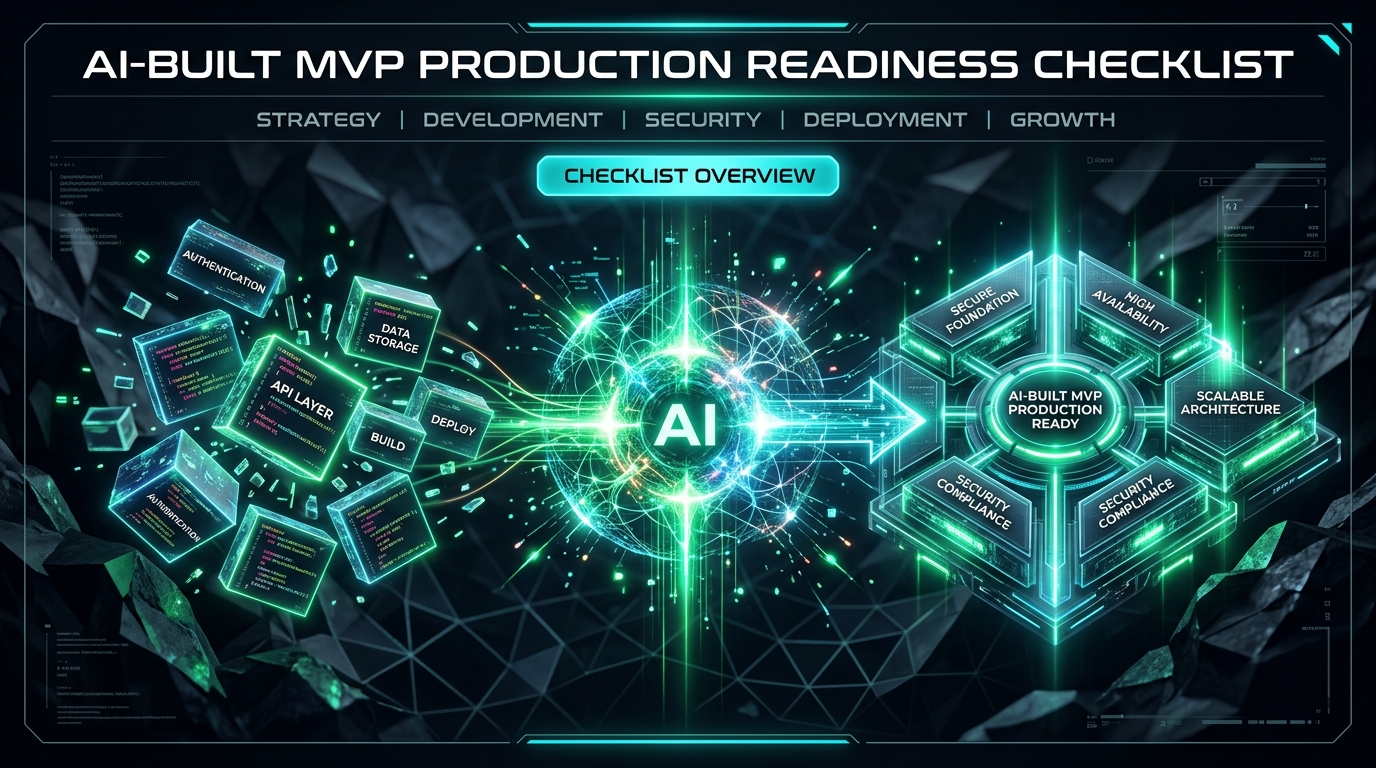
An AI-built MVP can be useful long before it is ready for production. It may demonstrate the workflow, win early feedback, or help a founder test demand. Production begins when real people, data, money, or business operations depend on it—and that changes the standard.
The goal of this checklist is not to turn a small product into an enterprise platform. It is to identify the minimum evidence needed to operate, change, and recover the product responsibly. Use it before onboarding real customers, accepting payments, storing sensitive information, or committing the MVP to an important business process.
Prototype complete does not mean production ready
A prototype proves that a path can work under expected conditions. A production product must also handle invalid input, interrupted requests, expired sessions, duplicate actions, permission failures, service outages, data changes, and releases that do not go as planned.
AI-assisted development does not create a separate definition of production readiness. The same responsibilities still exist: someone must understand the system, control access, protect data, verify critical behavior, monitor failures, and recover from a bad release. If nobody can provide evidence for those responsibilities, the product is still an experiment.
1. Confirm ownership and reproducible setup
Start with the simplest ownership test: can a competent engineer receive the repository and run the product without depending on the original chat history or the founder's memory?
- The business controls the source repository and relevant organization accounts.
- The README explains local setup, required services, environments, and common commands.
- Dependencies install from a committed lockfile.
- Important architectural decisions and known limitations are recorded.
- Production access is assigned to named, authorized people rather than shared informally.
If setup cannot be reproduced, every later security, testing, and release check becomes unreliable. Fix this before adding more features.
2. Separate environments, configuration, and secrets
Development, testing, staging, and production should not silently share the same database, storage bucket, API credentials, or third-party account. Configuration must be explicit, and secrets must stay out of source code and browser-delivered files.
Inventory every external service, credential, webhook, scheduled job, and environment variable. Confirm who owns each account, how access is revoked, and how a replacement secret reaches the application. The OWASP Secrets Management guidance is a useful reference, but the implementation must match the product's actual platform and risk.
3. Protect data before collecting more of it
Document what data the product stores, why it is needed, where it travels, and who can access it. Remove fields collected only because the generated schema happened to include them.
- Database changes use reviewed, repeatable migrations.
- Important writes are protected against accidental duplication or partial completion.
- Backups exist for critical data, and a restore has been tested.
- Deletion, retention, and export behavior match the product's approved policy.
- Logs do not expose passwords, tokens, payment details, or unnecessary personal information.
A backup that has never been restored is only an assumption. Test recovery before the product becomes difficult to reconstruct.
4. Verify authentication and authorization separately
Authentication answers who the user is. Authorization answers what that user may do. A product can have a polished login screen and still allow one account to read or modify another account's data through an unprotected API route.
Trace every sensitive action from the interface to the server and data store. Verify access on the trusted server side, not only by hiding buttons in the browser. Include account recovery, session expiry, administrative actions, and role changes. OWASP ASVS provides a practical control catalogue for web application verification; select controls according to the application's risk rather than claiming blanket compliance.
5. Validate input and protect important workflows
Assume that requests can arrive without using the intended interface. Validate structure, type, length, range, and business rules at the server boundary. Protect uploads, URLs, search fields, webhooks, and integration payloads as carefully as visible forms.
Then review abuse cases: repeated submissions, password guessing, invitation misuse, excessive resource consumption, fake signups, and actions performed in the wrong order. Rate limits and idempotency are product-specific; add them where failure would create cost, duplicate records, or inconsistent state.
6. Test the flows the business cannot afford to lose
Do not chase a coverage percentage for its own sake. Identify a small set of critical journeys and leave automated checks that fail when those journeys break.
- A user can create, access, and recover an account where accounts exist.
- Permission boundaries prevent cross-account access.
- The main product action succeeds and reports failure clearly.
- Payments, credits, bookings, or other valuable actions cannot be applied twice.
- A database migration can run against a realistic copy without losing required data.
Add manual release checks for behavior that is costly to automate or depends on third-party systems. The checklist should describe who runs each check and what evidence confirms success.
7. Make failures visible and actionable
A production team needs to know that an important flow failed before a customer explains it. Capture application errors with enough context to diagnose the problem, but without leaking sensitive data. Monitor availability and the few business-critical jobs or integrations whose failure would block users.
Define who receives alerts, what requires immediate action, and what can wait for normal working hours. This is an operating decision, not a reason to promise 24/7 support by default.
8. Review dependencies and software supply-chain risk
AI tools can add packages quickly, sometimes for a task the platform or standard library already handles. Remove unused dependencies, identify direct and transitive components, check licenses, and review known vulnerabilities in the versions actually shipped.
The CISA SBOM resources explain ways to document software components. A formal SBOM may not be necessary for every small MVP, but the team should at least know what it is deploying and how urgent updates will be handled.
9. Prepare a controlled release and rollback path
A repeatable build should produce the release from reviewed source. Before deployment, record the version, database changes, configuration changes, verification steps, and person authorized to approve the release.
Decide how to recover if the new version fails. Application rollback, database rollback, forward fixes, feature flags, and temporary service restrictions have different tradeoffs. Choose the smallest recovery path that protects data and restores the critical workflow, then test it in a non-production environment.
10. Record the remaining risks and assign owners
Production readiness is not a claim that every defect has disappeared. It is a decision that the known risks are understood, the highest-impact failures have controls, and named people own the remaining work.
Use a short risk register with the issue, affected users or data, likelihood, impact, current control, owner, and target decision date. The NIST Secure Software Development Framework offers a broader reference for integrating secure practices into software delivery; an MVP can adopt the relevant practices without copying an enterprise process wholesale.
How to decide whether the MVP is ready
Classify each checklist area as evidenced, incomplete, or unknown. Unknown is the most important state: it means the team has not yet inspected the real path. Resolve unknowns around access, data loss, payments, privacy, and critical operations before launch.
Lower-impact gaps can become an explicit post-launch plan when there is an owner, a deadline, and a safe temporary control. Do not turn every improvement into a launch blocker, but do not label a risk acceptable merely because the interface appears finished.
Need an evidence-based production checkpoint?
VNFlatform's AI Code Rescue & Product Hardening path begins with a paid technical audit of the existing product. The audit establishes what can be preserved, what creates material risk, and what work should be estimated before production or further scaling.
For a broader takeover review, use the Inherited Codebase Audit Checklist to map ownership, critical workflows, data, dependencies, and delivery risk before estimating or rewriting.
If the product is still exploratory, read Vibe Coding for Non-Technical Founders first. If real users or operations already depend on it, a focused audit is the safer next step.
The practical production rule
Do not ask whether the AI-built MVP looks ready. Ask whether the team can explain it, reproduce it, protect it, observe it, change it, and recover it. Production readiness begins when those answers are supported by evidence.