
Technical Debt in an MVP:
What Must Be Fixed
Before You Scale

VNFlatform Engineering Team
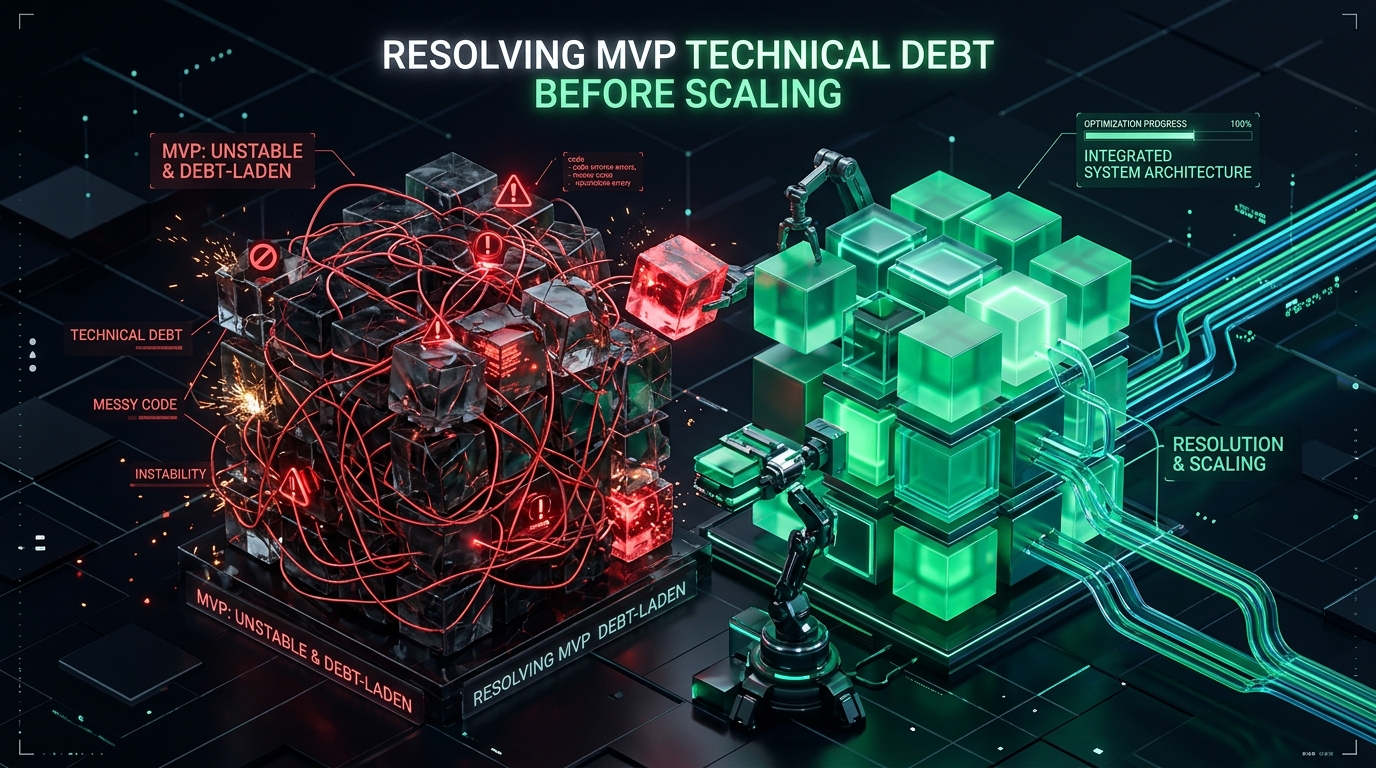
Every MVP contains compromises. That is not automatically a problem. The purpose of an MVP is to test an important assumption with limited investment, not to predict every future requirement. Debt becomes dangerous when the product starts carrying more users, data, revenue, integrations, or operational dependence than its original safeguards can support.
The goal before scaling is not to eliminate every imperfect file. It is to find the debt that can cause material harm, block safe delivery, or make recovery unreliable—and address it before growth increases the cost of failure.
Define debt by consequence, not appearance
Duplicated code, missing abstractions, old dependencies, manual deployments, weak tests, and unclear ownership can all be debt. Their priority depends on what they affect. A duplicated label is not equivalent to duplicated payment logic. A manual internal report is not equivalent to a manual production database migration.
Martin Fowler's Technical Debt Quadrant distinguishes deliberate or inadvertent choices and prudent or reckless behavior. The useful lesson for an MVP is to make compromises visible and manage them, rather than treating every shortcut as equal.
Fix trust-boundary debt first
Before growth, verify authentication, authorization, input validation, secrets, administrative actions, file handling, API access, and sensitive logging. Security rules must run at the trusted boundary, not only in the interface.
Prioritize any path that can expose another customer's data, grant unintended privileges, execute an irreversible action, or leak credentials. These are not cleanup tasks to postpone behind feature work.
Protect data and recovery
- Use reviewed and repeatable schema migrations.
- Prevent valuable writes from being applied twice or left partially complete.
- Separate production data and credentials from development environments.
- Back up critical data and test a restore.
- Document deletion, retention, import, and export behavior.
Data debt compounds. A flawed schema or undocumented mutation is easier to repair with a small dataset and few integrations than after multiple products depend on it.
Make releases repeatable
A product should build from reviewed source with explicit configuration. Record the version, migration order, verification steps, approver, and recovery path. Remove production changes that exist only on one person's machine or one manually edited server.
Scaling traffic while releases remain unpredictable increases both incident probability and recovery time. A smaller, controlled release process usually creates more value than a broad architectural rewrite.
Test the workflows growth will amplify
Identify the actions that acquire users, grant access, change money or credits, create bookings or orders, process files, send messages, or update core business records. Leave runnable checks around their successful path, permission boundaries, duplicate requests, and important failure behavior.
Do not use a coverage percentage as the only signal. One critical untested workflow can matter more than hundreds of covered helper functions.
Add enough visibility to operate the product
Capture errors with context, identify releases in runtime data, monitor critical jobs and integrations, and define who reviews alerts. Logs should help diagnose failures without exposing private data or secrets.
If the team learns about every failure from a customer, growth will create more support noise without improving understanding.
Review dependency and platform debt
Inventory direct and transitive dependencies, runtime versions, build plugins, container images, and external services. Prioritize known exploitable vulnerabilities, unsupported platforms, unclear licenses, and packages that block required upgrades or reliable builds.
Do not upgrade everything merely because a newer version exists. Review compatibility, test critical paths, and separate urgent risk from routine maintenance.
Clarify ownership before adding capacity
Record who can release, change infrastructure, approve data access, respond to incidents, and decide whether a known risk is accepted. Documentation should cover setup, environments, integrations, operational checks, and known limits.
Additional engineers do not automatically reduce debt. Without ownership and a safe path to change the system, they can create more parallel work around the same unknowns.
Debt that can often wait
Aesthetic inconsistency inside low-change code, minor duplication outside critical rules, generalized architecture for hypothetical scale, and replacement of a stable library solely because it is unfashionable may be deferred. Record the reason and the condition that would raise priority.
Do not build abstractions for future products that have not been approved. The smallest design that supports current verified needs is often easier to replace later than a speculative platform built too early.
Use a debt register that supports decisions
For each item, record the affected workflow, evidence, possible consequence, current control, likelihood, impact, remediation options, owner, and next review date. Group items into:
- Must fix before broader use.
- Fix alongside the next affected feature.
- Monitor with a defined trigger.
- Accept explicitly for the current product stage.
This turns “the codebase has debt” into work that can compete honestly with product priorities.
Do not use scaling as an automatic rewrite trigger
First identify the measured constraint. It may be a slow query, serialized job, oversized asset, unreliable integration, or manual operating step—not the entire architecture. Fix or isolate the smallest boundary that limits the next stage.
If a larger modernization decision remains, use the Refactor or Rewrite decision framework to compare preservation, stabilization, selective replacement, and rewrite risk.
Need to separate launch blockers from manageable debt?
VNFlatform's AI Code Rescue & Product Hardening path begins with a paid technical audit that ranks findings by evidence, consequence, and delivery dependency.
For a broader launch baseline, use the AI-Built MVP Production Readiness Checklist.
The practical debt rule
Fix debt that can compromise access, data, critical behavior, releases, recovery, or ownership before growth amplifies it. Track the rest with a reason, an owner, and a trigger—not a vague promise to clean everything later.